How Social Learning will Disrupt Traditional Corporate Training

If you have a corporate job, you most likely have experienced being required to take some type of online training courses. If you’re like me, you try to get through them as fast as possible so you can focus on your real work.

The crazy thing that I’ve found in the corporate world is that even as important as knowledge and learning are for the business, the way it’s facilitated is as if people are back in grade school.

Once an organization is large enough, say around 200 employees, they may have a Learning Management System where employees take quizzes and training courses. The reality though is that people are busy with their work so these training courses are only a required nuisance to ‘check the box’ than actually learning.

Real people learn from real experiences. I personally find it so much more valuable to look someone in the eyes and hear about how they dealt with a situation in a real-world setting.

Companies have a huge untapped asset regarding the knowledge and experiences of their people. The big question is how to effectively share knowledge in a way that is meaningful for both the individual and the business.

I believe the best way to share knowledge inside an organization is through Social Learning. Think back on the last time you went to lunch with someone you looked up to. That person may have shared experiences about a problem that you are dealing with. This intimate conversation has your attention and you’re engaged because someone is sharing knowledge about a topic that matters to you.

What if we applied this same scenario inside a company in a way that is more scalable? Instead of a lunch meeting, what if that person with experience and expertise shared their knowledge with 10 to 15 other employees in a meeting room. What if the business determined certain skills and knowledge that was critical for employees to have in order to achieve company goals and scheduled a series of such events to focus these topics?

A learning focused organization is a critical competitive advantage. Technology can help maximize knowledge sharing to occur across teams that is aligned back to specific business goals.

I believe there is a huge opportunity to disrupt the current stale model of corporate training. Organizations that invest in social learning across teams will benefit from employees that are engaged in learning skills and knowledge that better themselves and the business.

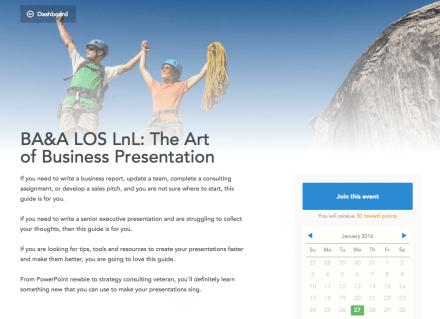
At Cooleaf, we’ve found that our product works very well to organize and manage employee knowledge sharing events. One customer example is Daugherty Business Solutions, who uses Cooleaf to create team events focused on sharing knowledge about specific skills and other categories that help grow their business.

Below is a snapshot of Daugherty’s community dashboard and a sample knowledge sharing event.

Screen Shot 2016-01-24 at 11.14.33 AM

Screen Shot 2016-01-24 at 11.17.33 AM


Taking Your Team on Tours of Duty

I recently read The Alliance, which was co-authored by Reid Hoffman (founder of Linkedin). In the book, the concept of employees taking a ‘tour of duty’ at their job was articulated as the best way to maximize the employee and employer relationship in this new age of the workforce. The Alliance

Back in the 50s and 60s, there was an expectation that you find a job and stay there for your career. Both the employer and employee bought into this mindset and as a result, both thought more long-term.

Now days employees have a much shorter view of their time at their employer. This is especially true in competitive work environments where there are lots of career options for employees to choose from.

The idea of an employee taking a tour of duty with a company is focused on establishing a short-term (1 to 2 years) goal where the employee is willing to invest their time, skills, and passion to achieve a personal goal such as growing a specific skill set or solving an interesting problem while their work results in significant value  for the business.

The employer wins because they get a highly engaged employee committing to a specific project or strategic initiative for the business while the employee wins by achieving a personal goal that is important for their career.

Once a tour of duty has been completed, perhaps the employee takes on a new tour of duty at the company in a new business unit or a new strategic project. It may seem counterintuitive, but I believe it’s in the best interest for both the employee and the manager to have an open conversation about the employee’s career path even when that path may lead to leaving the company. The reality is, an employee may leave your company regardless but at least you have the right of first conversation.

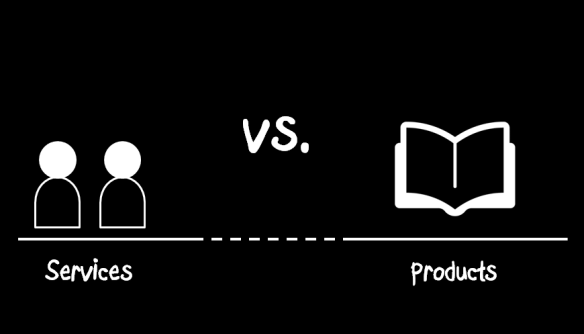
Are You a Service Company or Product Company?

service vs product

It’s a funny thing what you learn as you work to grow a company. We have pivoted multiple times at Cooleaf and we’re still learning every day. What matters most is traction and solving a problem for a customer that is important enough that they are willing to pay for it. That is easier said than done.

For some time we were troubled about being a service based company. At our core we loved technology and wanted to be a tech company. We transitioned into focusing our messaging to prospects on the product. What we learned is that people don’t buy your fancy product. They only buy a solution to their problem.

After building an incredible technology platform, we found it hard to sell. It was great to demo and we would get very positive feedback but the contract would never close. Our product would allow a customer to execute on an employee engagement strategy in great depth with extensive product features that we would tout. The problem was most of the prospects we talked to weren’t that great at creating an employee engagement strategy and they did not have a burning need to have a tool to manage it.

I find a similar analogy with marketing automation products such as Hubspot, which is a great tool if you know how to use it. We purchased this tool and let it sit on the shelf for about six months while we figured out our marketing strategy. It didn’t matter how many features the tool had, until we had our strategy in place we were not going to get value out of it. We found the same thing with Cooleaf and our customers.

Based on these learnings, we have embraced a services component to our company that lives in our Customer Success Manger role. By our team working with many customers in different industries we have learned best practices to achieve the greatest results that a customer is seeking. We now focus on the front-end strategy with a new customer that we call our on-boarding period which is basically a short project plan to lead a customer to being successful using our product.

We’ve found that some of our customers just want to be told what to do. I don’t blame them. It’s not their core business and they want us, ‘the experts’ to show them the best way to achieve their goals.

In the sales process now, I focus on understanding the customers end goals and share about how we can help achieve them rather than sharing product feature after product feature. This has been a lesson learned for me that I hope helps other founders to find their product traction.

5 Practical Steps to Improve Company Culture

Cooleaf Team

Most company leaders want to have a vibrant company culture and high level of employee engagement. However, leaders may lack the knowledge of practical steps to achieve these goals. Here are a few steps with specific actions that you and your team may use to improve your company’s culture.

Step 1:  Create new and more frequent opportunities for employees to connect

Guess what? Employees are people, and people generally get a lot of satisfaction out of being around other people they like and enjoy spending time with. The crazy thing is that in many organizations, employees never get to know each other as well, people!

Action: Send out a short survey with the goal of getting feedback as to the top interests that employees have. These interests can include both professional and fun/social categories.

Example categories may include things like running, volunteering, family/kids, mentoring, product innovation, future leaders group, women’s groups, etc… In the survey make sure to ask if the employee would be willing to help come up with new ideas and be a ‘champion’, or point of contact for an activity within a category they are interested in and if so, have them enter their name and e-mail (these employees may become group leaders).

Action: Create formal interest groups based on the top categories from the survey. Each group should have at least one champion, or group leader. It’s best to ask if someone would be interested in being a group leader for a short amount of time instead of them being assigned.

 Step 2:  Give your people a purpose

Giving a purpose does not need to be an abstract mission statement. It can be as simple as a goal for each interest group that is created. For example, let’s say you have a running group. Have the group champions understand that because there is a lot of interest from employees in running, you would like to use this group as a way for people to meet each other based on their common interest. Have the group champions decide how often the group should meet and what type of activities and events they should do.

Action: Work with group champions to define the goal for each group. Have them decide what type of activities the group will do and how often.

Action: Have your group champions create a schedule of activities and communications once the group goals have been set.

Step 3:  Recognize people for their contributions

You now have a solid foundation with employee interest groups, champions, and goals. Now it’s time for employees to see the value you place on their contributions and participation in the culture of your company.  Recognize people for achievements and participation. Recognition can be tied to rewards that are both financially based or as simple as a personal thank you.

 Action: Set up recognition categories that you will highlight when employees demonstrate those values. Examples may include recognition for participation, leadership,  going the extra mile, exemplary customer service, or being a technical ninja! You can have fun with the recognition categories based on what’s right for your culture. A best practice is to empower your group leaders with the ability to recognize their peers.

Step 4:  Focus on the first 30 days

Make sure that as part of all new hire on-boarding, new employees get introduced to the groups inside your company. This is a great way for new employees to meet their co-workers and feel part of a community. When people feel accepted and part of a community, they are more likely to stay!

 Action: Make it part of the on-boarding process for each new employee to have an opportunity to join interest groups. Not only should they join some of the groups, encourage new employees to participate in group events. It is a best practice to have a way to track the progress of new employees so that your team can be proactive in making sure they feel welcomed and accepted into the company’s culture.

Step 5:  Have fun

To be most effective, people need to enjoy what they do. A big part of employees enjoying what they do, is liking and respecting other people around them. Show your teams that it’s ok to have fun by you and other company leaders joining in on group activities. Just like everyone else, you should pick your interest groups and participate. Bottom line, have fun with it!

 Action: Make sure you and your leadership team pick their interest groups and participate. This is not just about being an example to other employees. This is about being authentic. Join in on the fun that is taking place and you may surprise yourself that not only are enjoying your time, but also how much it will mean for your team to see you out there side by side with them.

Finding Your Core as a Startup Company

Cooleaf is constantly evolving. We are learning everyday from customers. I truly believe in that as part of survival. I also believe there should be fundamental principles at your core as a company that guide you. These principles can be difficult to learn and I think we are just now starting to really understand them. I think you really don’t know what you stand for until you have stood for a little while. Because then you get tested, rejected, and ignored. That’s when you really see what you believe in.

Here is our story at Cooleaf to finding our core.

The initial product launch for Cooleaf was a web app. that allowed consumers to pick and choose fitness classes from health clubs and studios without having to be a member of the gym. Our idea was to give people more flexibility, get a discount, and earn rewards for signing up for healthy classes. We got some traction but it wasn’t sustainable.

We found that what we thought was our target market, active people who liked getting fit, actually didn’t really need our product because they already felt good about the gym or studio they were in. They were fine with their current routine. We weren’t solving a critical problem for them. There was also a segment of the market that did like trying new things and not being locked down into a membership but at the same time they were getting e-mails from Groupon and Living Social with deep discounts that we couldn’t offer.

We started evolving into the corporate space by allowing the HR Director for example to offer all their employees a corporate discount to the Cooleaf partner network based on a corporate rate we negotiated with health clubs and studios. We started to get more traction because the communication was going through a trusted source, being the company a person works for. We found this as a much more efficient marketing strategy for acquiring new users to our platform. However, it still didn’t change the fact that we were not solving a problem for people.

Around the same time as we were starting to work with employers for distributing the ‘corporate perk’ we called it, or employee discounts, we started organizing group events open to anyone to join. The first one we did was a IMG_0304kickboxing class at Atlanta Kick back in April of 2012. We promoted the event to our user base where we charged $5 for the class and then set up a happy hour afterwards. We figured we might as well have fun with this. People started showing up and bringing their friends. I remember thinking, ‘where did these people come from?’. It was a cool feeling to see people showing up to our event and having a good time.
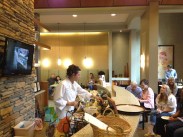
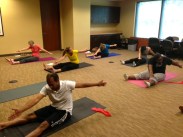

We found that doing things as a group made more sense for people to try something new. Even if the class wasn’t great, at least they were with friends to have a good time. It became more about having a fun or good experience as opposed to just a fitness session. We got feedback that people liked the idea of being able to meet others who also shared their passion.

As we continued with the group events, we started testing the idea of setting up group events that are private to the employees of a company. This meant for example, bringing in a chef to do a cooking demo at a company’s office, onsite yoga classes, or taking groups of employees to rock climbing outings. We found that employees loved it and employers were willing to pay for it. Based on the traction we were getting, we started focusing on offering awesome group experiences for employees at our employer clients.

IMG_0427Alere Pilates1IMG_0681

Typically the conversation with an employer client would start around offering a wellness program that their employees would actually want to participate in because it was based on fun activities that employees gave feedback on that they wanted to do. We  would also get feedback from company leaders that they would use our program as part of their new employee onboarding process to get new hires introduced into the organization and start meeting others. The idea of organizing awesome group outings become much more about team building and making the company a better place to work rather than trying to improve the health of employees. People getting healthy was more of a byproduct of what we did.

We believe the best way to have a strong, innovative culture for a company is by creating an environment that fosters employees to have authentic relationships with one another. We help make this happen for a company by organizing fun group activities that allow employees to connect with other employees based on common interest and having fun.

By no means do we have it all figured out. We’re not even close. We are still constantly evolving how we position ourselves and what we can offer to maximize the value to a customer based on understanding and solving their problems. From all of this customer discovery and self discovery, we have come to put a stake in the ground on the following core guiding principles.

  • Enabling people to connect with others through fun, active experiences resulting in authentic relationships based on common interests, goals, and affiliations.
  • Creating more fun, collaborative, authentic, and positive cultures in organizations through engaging experiences for people.