My interview with FreshBooks

I was recently interviewed by the team at FreshBooks (where my company is a happy customer by the way). Big thanks for helping me to share the Cooleaf story!

Here is the link to the original article: https://www.freshbooks.com/blog/customer-stories-company-culture

Customer Stories: Meet John Duisberg, Co-Founder of Cooleaf

If you take care of your employees, your employees will take care of your customers and your customers take care of your business.

Sounds simple, right? Yet so many companies don’t seem to get it right.

Enter Cooleaf.

Cooleaf helps businesses achieve better business results through a data-driven approach to company culture.

As many startups do, Cooleaf has evolved and pivoted over time. Launching in 2011, the business was initially a health and wellness solution. Then, it shifted to focus on employee engagement. Today, it offers an Agile Business Execution platform that helps businesses achieve their goals and improve business performance with sophisticated analytics.

John Duisberg is one of 3 Cooleaf founders. Many lessons have been learned throughout his entrepreneurial journey and he shares some of those insights with us.

Meet John and learn more about the evolution of Cooleaf.

TELL US ABOUT YOUR COMPANY, COOLEAF.

Cooleaf is focused on helping forward-thinking companies create a culture of engagement so they can attract and retain the best people for their business.

These days,companies need to connect their people to their brand in a more meaningful way. If their own people aren’t passionate about the mission and core values of the company, then how can your customers become passionate about it?

So, Cooleaf exists to help companies strengthen their brand’s value proposition in order to better connect with their employees. This way, they can strive to be a top workplace environment.

HOW DO YOU DEFINE CULTURE?

If you ask ten people what culture is, you’ll likely get ten responses. I personally believe that culture is something that has to be organic—it can’t be manufactured; however, you can be intentional and thoughtful in how you go about building culture.

We work with the leadership teams of our clients to find out what the mission and objectives of the company are. We dig deep to uncover their core values—what they want their people to live and breathe day-to-day. Then we ask ourselves: How can we help our client build a community that brings those core values to life?

AS EXPERTS IN THE AREA OF COMPANY CULTURE, HOW WOULD YOU DESCRIBE THE CULTURE LIKE AT COOLEAF?

We’re a small company now, so everyone works in the same room. It feels like a family. There are about 5 full-time employees at the moment and we’re all in it together, which is really fun.

The challenges come as you grow. We want to focus on preserving that entrepreneurial feel as we grow. We want every person to feel like they are an owner of the company and are invested in its long-term success.

WHAT WERE YOU DOING BEFORE YOU STARTED YOUR BUSINESS? AND WHAT MOTIVATED YOU TO QUIT YOUR DAY JOB AND START OFF ON YOUR OWN?

I worked for a healthcare technology company. I was very successful and I enjoyed what I did.

I worked with one of my now co-founders. At the time, we would have those coffee shop conversations and daydream about starting a business one day. But nothing ever came of those chats. Then, he left to work at another organization. At his new job, he met our third co-founder where those coffee shop conversations continued.

It started going beyond the coffee shop conversation when my former colleague introduced me to his new colleague. That’s when we actually started to take next steps like investing our own money and starting to design stuff.

We were all still working full-time jobs. Slowly but surely, we continued to put in more resources and build up our business. There were some things I wanted to have in place before I felt comfortable enough to go off on my own.

Firstly, I wanted to have a live product, not just a concept. Secondly, I wanted to make sure we had some seed funding in place so we wouldn’t just be burning our own cash. Lastly, I wanted to have a 12-month runway to save up so I could support myself through the bumpy road of entrepreneurship.

Once I had those three things in place I felt confident to take the leap and go all-in on our company.

IN YOUR EXPERIENCE, WHAT’S THE BEST WAY TO APPROACH SEED FUNDING?

Well as a first step, reach out to family and friends and ask: Is this something you’d be interested in?

When I reached out to potential seed funders, I didn’t just want them to contribute financially, but also to be on board as acting advisors. Because when they’re helping you become successful, they are more likely to buy-in to the achievements of your company.

Bring your seed funders in as strategic partners of your business beyond the financial means—that’s attractive to a lot of people.

WHAT ARE SOME OF THE LESSONS YOU’VE LEARNED ALONG YOUR ENTREPRENEURIAL JOURNEY?

  1. It’s going to take 4x longer than you expect and cost 5x more. So prepare yourself. Things will come up and problems will arise. You have to be prepared mentally and financially to be flexible and roll with the punches.
  2. Get some traction in the market before starting to pitch your product. Before going out and pitching, figure out how to build a minimum viable product (MVP) really early on. Figure out if customers will actually pay for the thing you’re offering. That’s the ultimate test.
  3. It’s all worth it in the end. Even though it’s very hard and there are soul-searching days when you get rejected… Remember: When you finally get that win and see a customer enjoying your product—it’s totally worth it.


WORKING WITH 2 OTHER CO-FOUNDERS. WHAT ARE SOME OF THE BENEFITS AND CHALLENGES THAT COME WITH THAT?

For us, it’s been a very good experience.

Being an entrepreneur can be very lonely. At times, you feel like you’re working on an island. So having co-founders can be very helpful in that respect.


Plus, different people bring different skills, a different network and different perspective to the table. Defining and understanding the roles of each person is really helpful. You’ll have to make decisions and move quickly in terms of the business and strategy. Being able to define your roles as co-founders is really helpful.

Keep this in mind: If you are going to work with co-founders, you’re going to be spending A LOT of time with these people, so there has to be professional respect there and you have to work to maintain it.

So, although there can be pros and cons to starting a business with one or two other people, I would absolutely recommend it. There’s a net positive that comes from that.

LOOKING FORWARD, WHAT’S NEXT FOR YOU AND COOLEAF?

It’s an exciting time for us. We have built out a very strong technology platform and we have validated it by bringing on customers over the past year. Some of them are very large customers like Turner Broadcasting for example.

The next stage is to grow and scale. We’re focussed on starting to build out a strategy around customer acquisition and how to make that a repeatable process. Investing in sales and marketing effort as well as developing from a channel partner standpoint.

As we head into the remainder of this year, I’m very excited about where we are and where we will go. We plan to be cashflow positive by the end of the year!

 

Pitching Cooleaf at 36|86

I had the opportunity to pitch my company, Cooleaf at this year’s 36|86 conference in Nashville. The conference is designed to highlight the best startup companies in the southeast and to connect investors and entrepreneurs. There was a $50,000 prize for the winning startup pitch along with lots of press. I have to say, the conference organizers did a really nice job and I’d recommend it to other entrepreneurs.

To be honest, I try not to do too many pitch competitions because they really don’t move the needle for your business.  It’s good to do every so often though to keep your edge. Believe me, when you have to be on stage in front of a couple hundred people and deliver a pitch describing your company, it forces you to be on point. I think it’s also good to feel that nervousness in your gut which is a reminder to me that I’m living!

My 3 Lessons Learned in B2B Sales

I have a background in product development. I’ve never been responsible for generating revenue until I started my company, Cooleaf. What I learned is that sales is hard. Really hard.

We’ve been through a lot at Cooleaf and we’ve had some really nice wins along with our share of rejections. The wins are so more meaningful because you know how hard they are to achieve. And it still hurts your soul when you’re rejected. Anyone who says it doesn’t is full of it.

Here are three lessons I’ve learned along the way. My hope is that you can take my lessons and apply them to your own startup.

  1. Sell to buyers that have budget and authority

Sorry to all my HR friends but HR is one of the worst place to sell into inside an organization. Exceptions can be made of course but in general, HR is a poor buyer because they are not a revenue generating part of the organization which means they have less authority when seeking budget. My advice is to NOT sell into a cost center for a company. Instead, pick a buyer such as head of sales or marketing who are in a direct path to revenue for their organization. I know for me, if my lead sales rep. came to me and said that if we buy this new software it would help them sell more, I would be interested.

  1. Make it easier to say yes by limiting the number of people who need to say yes

Top down sales slows your sales cycle significantly. When the whole organization has to adopt your product, it means that more people will be involved in the decision making process which means inevitably, you will experience a longer sales process. We’ve started working directly with team leaders such as a VP of X and offering a solution directly for them with their team. Our goal is to make them a champion to grow our product inside the organization. Even C-level people don’t want to make a decision to buy some new software unless they know their people will value it and adopt it.

  1. Remove the budget barrier

One of the most common barriers to a sale is the line, ‘we don’t have budget’. Well, why not just temporarily remove this barrier by offering a free trial or pilot of your product? I’ve found that one of the biggest fears a buyer has is that if they buy, what if the product fails to get adopted inside the organization. It’s less about the money and more about them looking bad that is the real issue. By letting them use the product first through a trial, it eases this concern. However, you have to be careful because people value what they pay for and that last thing you want is for the buyer to say that the trial didn’t workout but in reality it’s because they did not commit to using your product.

I’m still learning every day but these are a few of the lessons I’ve found meaningful. I hope you do too!

Are You a Service Company or Product Company?

service vs product

It’s a funny thing what you learn as you work to grow a company. We have pivoted multiple times at Cooleaf and we’re still learning every day. What matters most is traction and solving a problem for a customer that is important enough that they are willing to pay for it. That is easier said than done.

For some time we were troubled about being a service based company. At our core we loved technology and wanted to be a tech company. We transitioned into focusing our messaging to prospects on the product. What we learned is that people don’t buy your fancy product. They only buy a solution to their problem.

After building an incredible technology platform, we found it hard to sell. It was great to demo and we would get very positive feedback but the contract would never close. Our product would allow a customer to execute on an employee engagement strategy in great depth with extensive product features that we would tout. The problem was most of the prospects we talked to weren’t that great at creating an employee engagement strategy and they did not have a burning need to have a tool to manage it.

I find a similar analogy with marketing automation products such as Hubspot, which is a great tool if you know how to use it. We purchased this tool and let it sit on the shelf for about six months while we figured out our marketing strategy. It didn’t matter how many features the tool had, until we had our strategy in place we were not going to get value out of it. We found the same thing with Cooleaf and our customers.

Based on these learnings, we have embraced a services component to our company that lives in our Customer Success Manger role. By our team working with many customers in different industries we have learned best practices to achieve the greatest results that a customer is seeking. We now focus on the front-end strategy with a new customer that we call our on-boarding period which is basically a short project plan to lead a customer to being successful using our product.

We’ve found that some of our customers just want to be told what to do. I don’t blame them. It’s not their core business and they want us, ‘the experts’ to show them the best way to achieve their goals.

In the sales process now, I focus on understanding the customers end goals and share about how we can help achieve them rather than sharing product feature after product feature. This has been a lesson learned for me that I hope helps other founders to find their product traction.

Don’t Tell Me About Your Product – Give Me 3 Outcomes

show_up_throw_up

My old boss, Mike Neeley used to tell me, ‘don’t just show up and throw up’. I now really understand what he meant.

Recently I was giving a product demo to serial entrepreneur, Brandon Lee. He stopped me midway through my pitch and said, ‘the product looks great, but give me 3 outcomes for what it will do for me’.

In other words, he was saying ‘hey, I don’t really care about your product. I only care about what it will do for me’.

I think it’s easy to get lazy and just pitch your product. It takes time and effort to do the homework to really understand what your potential customer cares about and what your product can do for them.

Thinking about this advice, here are my thoughts for my company, Cooleaf. To give context, we have a technology platform that companies use to manage all of their internal employee programs such as training, wellness, volunteering, social events, and recognizes employees for their level of participation and accomplishments.

Three outcomes for our clients:

  1. Cooleaf will make a large organization feel small – we help connect people inside the organization based on common interests and things people can get plugged into to meet others and build relationships resulting in a stronger company culture
  1. Cooleaf will enable company leaders to track the results of investments in their employees, – by leaders having real data, they are empowered to make more strategic and proactive decisions for their investments in programs for their people
  1. Cooleaf will power a rewards and recognition program for employees – organizations can recognize employee accomplishments and participation in the culture and success of the company

Before speaking with (not to) a client, I encourage you to first do your homework about their needs and understand your connection to them. Then be clear about what your product can do for them and ask the client to prioritize what is most important to them. This will allow you to focus your pitch to what they care about most.

Life in a Startup – Walking a Line Between Death and Greatness

whiteboarddesignby_Ursula

My co-founder, Prem Bhatia likes to say that the default state of a startup is failure and each startup is furiously working to avoid that state until it finds product-market-fit. He is absolutely right.

Last year was a good year for my company, Cooleaf. We grew our revenue by 477%. I preference that number by saying that it’s a lot easier to put up a big number like that when you’re starting small, but regardless, it’s strong growth. We implemented a new iteration of our product last March and were able to close several large enterprise deals. Our largest contract being $50K.

This all sounds great and it is. However, it still is not good enough. Despite having our best year ever with huge potential in the future, we are still working towards achieving product-market-fit and being financially secure. We have steady MRR (Monthly Recurring Revenue) and are growing but we also have grown our expenses, primarily investing in our technology.

Based on the feedback we get from customers and our own market discovery work, we believe there is a path to scale the business faster through our product. We are seeing more frequent and stronger signs of product-market-fit and therefore, we plan to continue investing in our technology to get us there.

One big challenge we face is that B2B enterprise sales cycles are long. Much longer than we expected. We’ve found that company leaders can absolutely love our product but since there is no line-item in their budget, we have to wait until the next budget cycle to get approved which may take a full year. This puts a strain on cash flow for a small company like us. Bottom line is that we have to find ways to shorten the sales cycle by providing more value through our product resulting in it being considered a ‘must-have’ for the the customer.

It is a strange feeling that can only be summed up as being part of the life of a startup when you have the sheer excitement of that feeling in your gut that you are on to something really big, all the while feeling a burning on the back of your neck from the pressure knowing that the clock is ticking and you have no choice but to fight like hell every day to survive.

Here is to kicking some ass and breaking glass in 2015!

Management Innovation – Using Agile with Non-Development Teams

I recently participated in a leadership event hosted by the Atlanta Tech Village where a group of startup company leaders along with leaders from fortune 500 companies met to discuss how they use Agile Methodology  in their organizations. At this event I got a chance to speak with Tami McQueen, Marketing Director at Salesloft.

Tami spoke to the group about how she used an Agile Methodology to manage her marketing team. This came as  surprise to me because I was familiar with using Agile only in product development.  I later met with her to go in detail about how she managed her team.

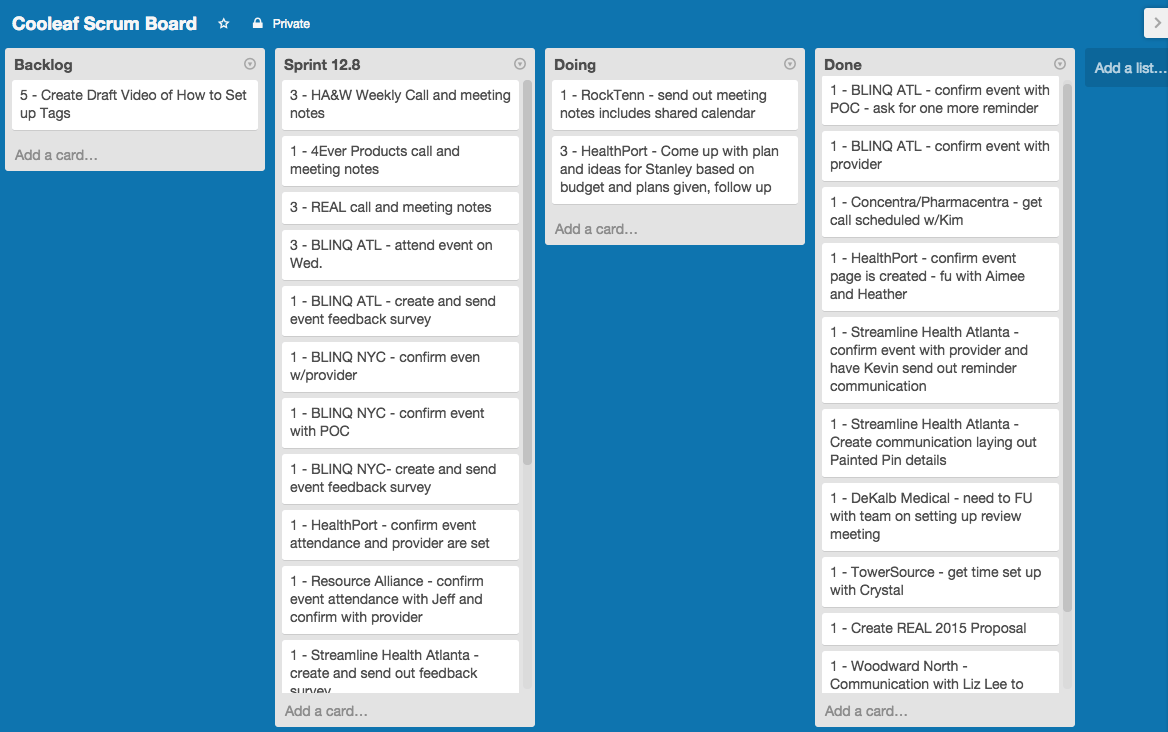
Each week, her marketing team organizes a Sprint. They use a tool called, Trello to manage this process. Each unit of work gets a card created to track it where a point value and owner is assigned. The point value is based on the amount of time estimated to complete the task. They assign cards with point values of 1 being about an hour or less of work, 3 being a couple hours task, and a 5 being a mini project requiring approx. a half day of work.

Each week there is a Sprint planning meeting where all the work for that week is organized into cards and assigned points and a team member who takes ownership to compete the task. Each team member is given a specific number of points for their workload. They use 30 points per team member but this is something that may vary by the team and type of work. Each morning there is a short Scrum meeting to check-in on the tasks and communicate priorities for the day. There are goals set for the team to be able to successfully complete consecutive Sprints, meaning all work that the team committed to getting done was completed.

The success that Tami had with using an Agile Methodology for her marketing team inspired me to adopt this process for our team at Cooleaf. I decided to impelment this process for our team to manage the Account Management work that we do on a weekly basis. Our Sprint is summarized in the picture below. We just started using this process so I will write a post in the future about our results and lessons learned. I do believe that Agile can be used beyond development teams and I’m looking forward to seeing what we can do.

Screen Shot 2014-12-08 at 7.51.44 PM

Getting Closer to Product-Market Fit

There is a lot of talk about the idea of achieving Product-Market fit. Successful entrepreneurs such as David Cummings discuss this topic regularly on his blog.

Achieving product-market fit is one of those things where you can’t always define it, but you know when you have it.  My view is that when your company has brought on 5 new consecutive clients for the same product and for the same value proposition, then you most likely have product-market fit.

Continue reading

Cooleaf on The Atlanta Tech Edge

We recently had the opportunity to tell the Cooleaf story on NBC’s Atlanta Tech Edge show. This was the first time that we’ve been interviewed on TV so it was a cool experience.

Big thanks to Angel Maldonado, producer of the show for having us out. We had a great time!


Cooleaf on the Atlanta Tech Edge

Check out the interview here.

We also got a behind the scenes tour of the studio right before we starting taping the show. It was a cool experience and made me feel proud to be sharing my story about Cooleaf.

IMG_2556

Starting to Build a Company Culture

Cooleaf on the door

I have to admit it, there is something about seeing your own company’s name on the door that makes you want to keep coming back for more and pushing harder than you ever have before.

I’ve absolutely been humbled working to grow my company, Cooleaf. We’ve evolved so much since when we started and I have a learned so much from the experience and have plenty of battle scars to show for it. Last November we moved into an office at the Atlanta Tech Village and it has been awesome.

We struggled through a couple years trying to grow Cooleaf and all the while, keeping our burn rate as low as possible. We finally got to a point where it made sense to move into an office. When I see my company’s name on the door,  it is  just a very small reminder to me that we’ve been able to achieve something special and that ‘it’s possible’. This feeling lights a fire in me that wants more!

In today’s virtual world, it’s easy to make the argument that work can be done remotely and avoid the overhead of office space. I think people who think that way don’t understand the intangible value that comes from bringing a team together in one place.

IMG_2573

I believe it’s all the small laughs, F-bombs, and high-five’s that start to make up a culture for the company that can only be created when a team comes together. We recently started a tradition with our office neighbors at Gigabark that we would take shots when either company closed a new contract. I’m happy to say that we have a few more shots to take!