Traction Trumps Everything

Customer Traction

As an entrepreneur, chances are you will look for funding from investors at some point while growing your startup.

Pitching your company to investors can be a humbling experience for the entrepreneur. As a founder, you are passionate about your product and believe in the future growth potential for your company. Investors however, are skeptical and look to poke holes in the business.

You can’t blame an investor for not being interested in your business. There are many reasons why an investor may choose to pass on your company. The thing that is frustrating is when you get feedback from an investor that makes it obvious that they don’t understand your business.

I’m ok with an investor saying no, but at least know what you’re saying no to. Maybe it’s the entrepreneur’s fault for not being clear enough about how their company solves a critical problem in the market. Or maybe it’s the fault of the investor for not taking the time to understand the business. What I’ve learned is that it doesn’t matter.

There is only one thing that matters and that is traction.

If you have paying customers, then obviously they find value in your product. Customer traction trumps everything! It’s hard to argue with your paying customers.

The more customers, the more credibility your company has and the less you have to explain to a potential investor. At some point, if the investor still doesn’t understand your business even after you have shown legitimate traction, then you probably don’t want to be working with that investor anyway and you should look at it as them doing you a favor for not wasting any more of your time.

The Entrepreneur Mind – my interview with Kevin Johnson

Kevin and team

I recently read the book, The Entrepreneur Mind. The book is made up of 100 short stories of lessons learned by Kevin Johnson’s experience starting multiple companies, being an investor, and an entrepreneur. One of the chapters in the book is focused on People, which of course is of interest to me because of the focus that my company, Cooleaf has on building strong company cultures.

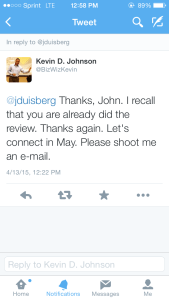
I decided to send a tweet to Kevin since he is local to Atlanta to see if he would be willing to meet. The cool thing was that within minutes he responded and was Tweet to Kevinopen to doing an interview. Here is a short summary of the interview I did with Kevin.

“People make the world go round. It’s all about people and relationships. Entrepreneurs who are most comfortable working with people will be most successful.”

Lesson #42 – Talent trumps seniority

In the book, Kevin shares a story about being a young developer for a company where there was what he called a ‘seniority complex’. In the story, his manager gave him a project to complete that had been dragging along for months in the company. Kevin spent the weekend knocking it out and presented the completed work the next Monday. Kevin was shocked to see his manager being yelled at for getting the project completed. Basically, by Kevin getting the work done so quickly, it made others look bad, especially since he was so young and a junior employee.

Effective organizations learn to remove the seniority complex and focus on performance above all else.

Lesson #44- People do not work for money


One of the stories Kevin wrote about in his book is how he hired people at high salaries for his first company. He found later that interns were just as productive and were willing to work for free. Why? Because they wanted the prestige of writing for a cool magazine (he published a college magazine for his first company). Kevin realized that people were willing to work for something they were truly passionate about.

I asked Kevin how you find people who have that internal passion and are willing to invest into your company. He said to always go with your gut but to also have as many people interview the person as possible. Also let the candidate you are interviewing come in and meet anyone from your company they would like to speak with to get the best understanding of your company’s culture.

Lesson #50 – Fire unproductive people

Making the hard decisions separates true leaders from the rest. I’ve personally experienced how hard it can be to let someone go that you know are not the right fit. In Kevin’s book he emphasizes that productive entrepreneurs are those who are decisive. He says that many entrepreneurs know the right decision but put it off for months before finally making the tough call. This lowers productivity and with a small organization, can be a drain on the entire culture.

When I interviewed Kevin about this point, he mentioned two ideas to think about when making tough decisions.


1. For those who have kids, you can be nice until you think about how the unproductive person who you are delaying letting go is getting in the way of your kid’s college fund. This will get you motivated to make some decisions when you make it personal. Regardless, it should be personal. After all, it’s your company.

2. One way to soften the blow for the employee being let go is to help them find a new role afterwards. Kevin says that if you kick someone in the teeth, at least you can help them find a dentist.

The Entrepreneur Mind

How Google Works

How Google Works“If everything seems under control, you’re not going fast enough.”         – Mario Andretti

I recently read a great book, How Google Works and recommend it for entrepreneurs, business leaders, and anyone looking to think bigger. Here are a few highlights that I found inspiring.

Don’t Look for Faster Horses

There is a quote by Henry Ford where he says that if he asked customers what they wanted, they would have asked for a faster horse, instead of a car. The bigger point in the book is that new products should be based on a specific ‘technical insight’, meaning the product is not just incrementally better than what already exits, rather it has significant technical advantages that pushes the product beyond the current market.

All product owners should be able to clearly answer the question, ‘what is your product’s technical insight?’.

OKRs – Objectives and Key Results

OKRs are the most important things that an employee is working on and how success is measured from the results of their work. Each quarter, every Google employee publishes their OKRs to the entire company. Starting with with the top, Larry Page and Eric Schmidt present their OKRs at an all employee meeting. This gives direction to the company overall and creates an environment of transparency. OKRs are published so all employees can look up any other employee’s OKRs which helps everyone understand what people are working on and what they are passionate about.

Review Yourself

A golden rule for management is to make sure you would work for yourself. In the book, it is suggested for you to write an actual review of your own performance and then share it with the people who work for you. The main point is that if you wouldn’t like to work for yourself, other people probably don’t want to work for you either.

E-mail Wisdom

Respond quickly. In the book, they make the point that some of the best and busiest people are known to be prompt on e-mail. And not just responding quickly to certain people, but to everyone. This encourages a flat organization and speeds up the pace of work. A response can be as simple as, “got it”.

Think Big

Think Big

In the book, the observation is made that most people tend to think incrementally rather than transformationally. It is common to here “you’re not thinking big enough” or “think 10X”, at Google.

It’s those who truly think big in ways that are thought not to be possible, who push innovation.

What ‘Could’ Happen in the Next Five Years?

New products, businesses, and industries are created when you can imagine what ‘could’ happen. When you remove the shackles of today’s limitations you can open up a new world of innovation. In the book, questions are posed such as “do your customers love your product?” and “do your customers use your product regularly?”. Asking questions about what ‘could’ happen will lead to new ideas and possible innovation which drives the company forward.

My dad got me this book, How Google Works as a gift and I recommend it to any entrepreneur or business leader interested in innovation and growing a company.

Connecting Talented People in Atlanta

SanboxCrew

There is a relatively new organization in Atlanta called Sandbox Crew, being led by local tech startup community guru, Scott Henerson. The organization has been operating somewhat in stealth mode for the last couple months and is now ready to open up to the public.

The idea behind Sandbox Crew is to connect talented people in Atlanta to strengthen the community overall. This sounds a bit broad but if you’ve ever been to a ‘networking’ event, you know that you really don’t truly meet others. It’s more of a shaking hands and swapping business cards type of formality. The goal of Sandbox Crew is to create small gatherings for people to discuss specific topics of interest and really get to know others within an event or group resulting in more authentic relationships.

The vision of Sandbox Crew attracted me for a couple reasons. One, because I personally want to surround myself around intelligent and passionate people that are interested in bettering the community overall. The idea of creating stronger connections to strengthen a community is also aligned with my company Cooleaf, where we believe that creating more authentic relationships is the foundation of a strong company culture overall.

If you are interested in meeting other ATL leaders on a deeper level with the purpose of pushing the Atlanta Tech scene further, check out Sandbox Crew.


Don’t Tell Me About Your Product – Give Me 3 Outcomes

show_up_throw_up

My old boss, Mike Neeley used to tell me, ‘don’t just show up and throw up’. I now really understand what he meant.

Recently I was giving a product demo to serial entrepreneur, Brandon Lee. He stopped me midway through my pitch and said, ‘the product looks great, but give me 3 outcomes for what it will do for me’.

In other words, he was saying ‘hey, I don’t really care about your product. I only care about what it will do for me’.

I think it’s easy to get lazy and just pitch your product. It takes time and effort to do the homework to really understand what your potential customer cares about and what your product can do for them.

Thinking about this advice, here are my thoughts for my company, Cooleaf. To give context, we have a technology platform that companies use to manage all of their internal employee programs such as training, wellness, volunteering, social events, and recognizes employees for their level of participation and accomplishments.

Three outcomes for our clients:

  1. Cooleaf will make a large organization feel small – we help connect people inside the organization based on common interests and things people can get plugged into to meet others and build relationships resulting in a stronger company culture
  1. Cooleaf will enable company leaders to track the results of investments in their employees, – by leaders having real data, they are empowered to make more strategic and proactive decisions for their investments in programs for their people
  1. Cooleaf will power a rewards and recognition program for employees – organizations can recognize employee accomplishments and participation in the culture and success of the company

Before speaking with (not to) a client, I encourage you to first do your homework about their needs and understand your connection to them. Then be clear about what your product can do for them and ask the client to prioritize what is most important to them. This will allow you to focus your pitch to what they care about most.

5 Practical Steps to Improve Company Culture

Cooleaf Team

Most company leaders want to have a vibrant company culture and high level of employee engagement. However, leaders may lack the knowledge of practical steps to achieve these goals. Here are a few steps with specific actions that you and your team may use to improve your company’s culture.

Step 1:  Create new and more frequent opportunities for employees to connect

Guess what? Employees are people, and people generally get a lot of satisfaction out of being around other people they like and enjoy spending time with. The crazy thing is that in many organizations, employees never get to know each other as well, people!

Action: Send out a short survey with the goal of getting feedback as to the top interests that employees have. These interests can include both professional and fun/social categories.

Example categories may include things like running, volunteering, family/kids, mentoring, product innovation, future leaders group, women’s groups, etc… In the survey make sure to ask if the employee would be willing to help come up with new ideas and be a ‘champion’, or point of contact for an activity within a category they are interested in and if so, have them enter their name and e-mail (these employees may become group leaders).

Action: Create formal interest groups based on the top categories from the survey. Each group should have at least one champion, or group leader. It’s best to ask if someone would be interested in being a group leader for a short amount of time instead of them being assigned.

 Step 2:  Give your people a purpose

Giving a purpose does not need to be an abstract mission statement. It can be as simple as a goal for each interest group that is created. For example, let’s say you have a running group. Have the group champions understand that because there is a lot of interest from employees in running, you would like to use this group as a way for people to meet each other based on their common interest. Have the group champions decide how often the group should meet and what type of activities and events they should do.

Action: Work with group champions to define the goal for each group. Have them decide what type of activities the group will do and how often.

Action: Have your group champions create a schedule of activities and communications once the group goals have been set.

Step 3:  Recognize people for their contributions

You now have a solid foundation with employee interest groups, champions, and goals. Now it’s time for employees to see the value you place on their contributions and participation in the culture of your company.  Recognize people for achievements and participation. Recognition can be tied to rewards that are both financially based or as simple as a personal thank you.

 Action: Set up recognition categories that you will highlight when employees demonstrate those values. Examples may include recognition for participation, leadership,  going the extra mile, exemplary customer service, or being a technical ninja! You can have fun with the recognition categories based on what’s right for your culture. A best practice is to empower your group leaders with the ability to recognize their peers.

Step 4:  Focus on the first 30 days

Make sure that as part of all new hire on-boarding, new employees get introduced to the groups inside your company. This is a great way for new employees to meet their co-workers and feel part of a community. When people feel accepted and part of a community, they are more likely to stay!

 Action: Make it part of the on-boarding process for each new employee to have an opportunity to join interest groups. Not only should they join some of the groups, encourage new employees to participate in group events. It is a best practice to have a way to track the progress of new employees so that your team can be proactive in making sure they feel welcomed and accepted into the company’s culture.

Step 5:  Have fun

To be most effective, people need to enjoy what they do. A big part of employees enjoying what they do, is liking and respecting other people around them. Show your teams that it’s ok to have fun by you and other company leaders joining in on group activities. Just like everyone else, you should pick your interest groups and participate. Bottom line, have fun with it!

 Action: Make sure you and your leadership team pick their interest groups and participate. This is not just about being an example to other employees. This is about being authentic. Join in on the fun that is taking place and you may surprise yourself that not only are enjoying your time, but also how much it will mean for your team to see you out there side by side with them.

Give Your Team a Compass, Not a Roadmap – my interview with Kat Cole

“Many leaders try to dictate results without having a real connection with their teams. This is where their efforts fall short. People learn from experiences, which gives them beliefs and turns into action, which drives results.”

John and KatRecently, I was fortunate enough to sit down with Kat Cole, President of Focus Brands. There are few people that I’ve met that have a true presence in a room and Kat is one of them. During our conversation she enlightened me with several nuggets of practical knowledge based on her journey as a successful leader and being an all-round good person.

 Kat has an inspiring story where she started working as a Hooters waitress and quickly rose through the ranks to company Vice President in just a few years. From there she was recruited into leading Cinnabon, a Focus Brands company and has most recently taken on the role of President for overall Focus Brands.

To give context to the breadth of Focus Brands, it is a the franchisor and operator of more than 4,000 ice cream shops, bakeries, restaurants and cafes in the United States, the District of Columbia, Puerto Rico and 60 foreign countries under the brand names Carvel, Cinnabon, Schlotzsky’s, Moe’s Southwest Grill, Auntie Anne’s Pretzels and McAlister’s Deli.

I was interested in learning more about what she did to achieve such growth in a short amount of time and how she instills these principles into the teams that she leads today.

“When you have a genuine desire to learn, that is evidence that you recognize that you don’t know everything and have a deep level of humility – this is incredible disarming for people”

Kat revealed that she will be a lifelong student. She attributes her success to helping others and by doing so, learning from new experiences. For example, Kat described taking on many different roles during her time at Hooters and as a result, learned every aspect of the business.

Many of these roles started by simply helping people when they needed it. One day while working at Hooters, the cooks walked out on the restaurant and Kat decided to get in the kitchen and start taking food orders. She had never done that before so she wanted to know for herself that she could do it, and after all, it needed to be done.

By being humble enough to listen and being willing to learn all aspects of the business, Kat believes that she is able to see and identify opportunities that others may miss. One example she gave was when evaluating an investment in a restaurant. While others were speaking with the management, she went straight to the dishwasher and asked what he saw being thrown away most often.

“People need to ask the right questions and to the right people.” Often the most insight can be gained from the output or end of the process. This may be how the frontline employee interacts with a customer and the experience that the customer has at that moment.”

Another point that Kat emphasize is the importance of ‘thinking big’. She urges people around her to think beyond their current situation and what they think they can achieve. I liked the idea of this but wanted to learn more specifically how can one do this. Kat explained that the best way to teach people to think bigger is by putting a person in a brand new experience where they are forced to learn new things and interact with people and in way that they have never done before.

One example Kat told me about was her time volunteering in Africa where because the people in the village her group was attending to had such limited resources, it forced them to pick the single most important thing they could do to help and have the largest positive impact.

This forced her group to look at the problem in a new a way and prioritize to the most extreme level what they could do for the people they were there to help. It turned out that the number one thing that they could do was to help the people in the village have a more accessible water supply. All else would not matter if this single thing were not done.

When Kat got back to Cinnabon after her trip, her team was in the middle of selecting new menu items and doing a massive amount of research to make sure their new products would be a hit. Kat put a stop to it all right in the middle of its tracks. She asked her team what was the single most important thing they could do for their customers and brand. They ended up implementing new digital menu displays that were visible from afar so people passing by in stores, in malls and airports, etc… could see the existing menu options that Cinnabon offered.

Cinnabon did not need a new menu option but just a way to increase awareness of the variety of options they already had. Kat feels that by putting herself in a completely new experience she was able to look at a problem in a different light and think bigger than their current environment. The franchisees that implemented the new digital signage showed an increase in sales by over 400% compared to those franchise stores that did not implement the digital menus, in case you were wondering.

Meeting Kat inspired me to be better. She inspired me to think about how I can personally grow, to be humble, and willing to learn from every person and situation. Kat is successful because she pushes herself everyday to think bigger. She encourages those around her to push themselves to greatness. I know now to trust my ‘internal compass’ and know when I hit roadblocks and need to find a new path, I’ll be going in the right direction.

The Workforce is Changing

millennialsThe best thing that can help a startup grow is to be part of a large trend that is moving the market.

There is a macro trend occurring beneath the feet of corporate America where an older generation of employees are exiting the workforce and a new, younger generation (millennials) are entering the workforce. Within 10 years, the millennial generation is predicted to account for 75% of the global workforce.

This new generation of employees seek different things from their employer. A sense of meaning, growth potential, and their work environment matter much more to this younger generation of employees.

Leaders in companies are waking up to this trend and looking for new solutions to the knowledge gap that has been created due to the generational divide in the workforce. Enterprise Social Networks (ESNs) are becoming more standard as leaders seek more efficient ways to communicate and better connect their teams. Leaders are now looking to adopt solutions but in a way that they have more control and can be strategic about how their collaboration solution is aligned to the goals of the business.

I believe that existing ESNs have failed to actually connect people because these solutions have only focused on being a communication tool. Real knowledge sharing and learning happens not from online courses or from virtual discussion threads, but from real people sharing real-life experiences. By bringing people together around categories that people have a passion for and also support the business, individuals and teams are able to connect and collaborate in a more meaningful way where the growth of the individual results in the growth of the organization.

I’ve personally spoken with many top leaders inside companies about their key focus areas for this year and knowledge exchange and attracting and retaining the best talent are top on the list.

Life in a Startup – Walking a Line Between Death and Greatness

whiteboarddesignby_Ursula

My co-founder, Prem Bhatia likes to say that the default state of a startup is failure and each startup is furiously working to avoid that state until it finds product-market-fit. He is absolutely right.

Last year was a good year for my company, Cooleaf. We grew our revenue by 477%. I preference that number by saying that it’s a lot easier to put up a big number like that when you’re starting small, but regardless, it’s strong growth. We implemented a new iteration of our product last March and were able to close several large enterprise deals. Our largest contract being $50K.

This all sounds great and it is. However, it still is not good enough. Despite having our best year ever with huge potential in the future, we are still working towards achieving product-market-fit and being financially secure. We have steady MRR (Monthly Recurring Revenue) and are growing but we also have grown our expenses, primarily investing in our technology.

Based on the feedback we get from customers and our own market discovery work, we believe there is a path to scale the business faster through our product. We are seeing more frequent and stronger signs of product-market-fit and therefore, we plan to continue investing in our technology to get us there.

One big challenge we face is that B2B enterprise sales cycles are long. Much longer than we expected. We’ve found that company leaders can absolutely love our product but since there is no line-item in their budget, we have to wait until the next budget cycle to get approved which may take a full year. This puts a strain on cash flow for a small company like us. Bottom line is that we have to find ways to shorten the sales cycle by providing more value through our product resulting in it being considered a ‘must-have’ for the the customer.

It is a strange feeling that can only be summed up as being part of the life of a startup when you have the sheer excitement of that feeling in your gut that you are on to something really big, all the while feeling a burning on the back of your neck from the pressure knowing that the clock is ticking and you have no choice but to fight like hell every day to survive.

Here is to kicking some ass and breaking glass in 2015!

Management Innovation – Using Agile with Non-Development Teams

I recently participated in a leadership event hosted by the Atlanta Tech Village where a group of startup company leaders along with leaders from fortune 500 companies met to discuss how they use Agile Methodology  in their organizations. At this event I got a chance to speak with Tami McQueen, Marketing Director at Salesloft.

Tami spoke to the group about how she used an Agile Methodology to manage her marketing team. This came as  surprise to me because I was familiar with using Agile only in product development.  I later met with her to go in detail about how she managed her team.

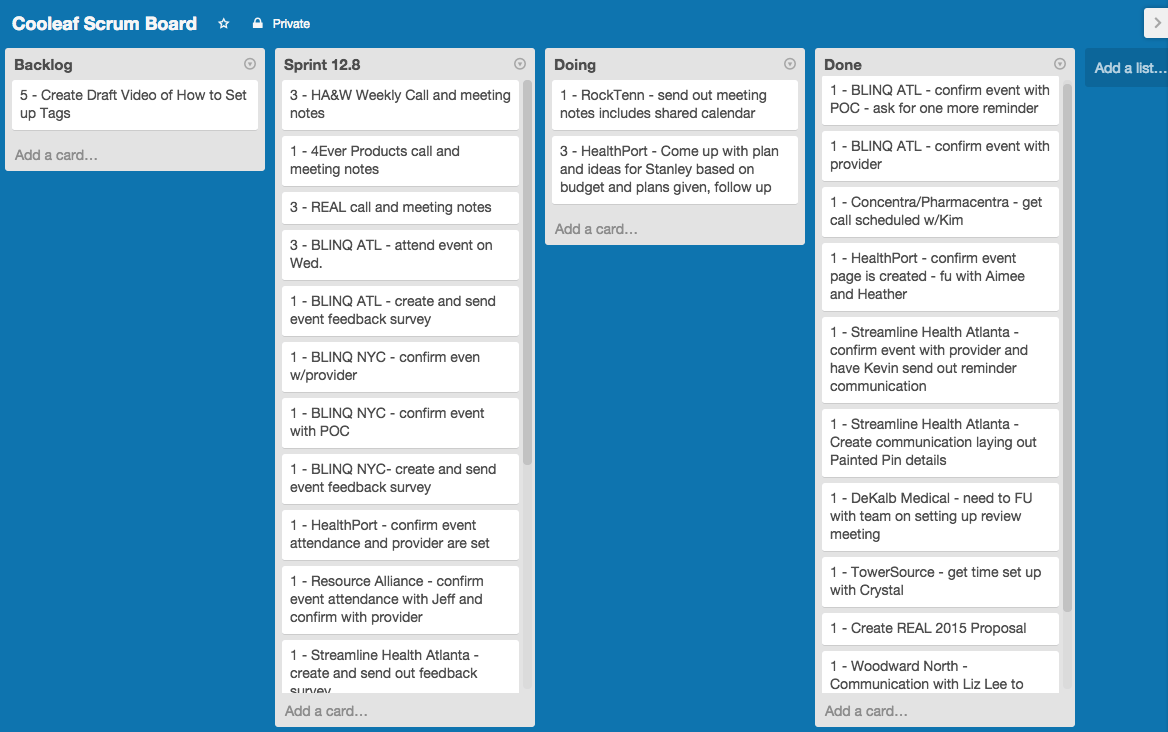
Each week, her marketing team organizes a Sprint. They use a tool called, Trello to manage this process. Each unit of work gets a card created to track it where a point value and owner is assigned. The point value is based on the amount of time estimated to complete the task. They assign cards with point values of 1 being about an hour or less of work, 3 being a couple hours task, and a 5 being a mini project requiring approx. a half day of work.

Each week there is a Sprint planning meeting where all the work for that week is organized into cards and assigned points and a team member who takes ownership to compete the task. Each team member is given a specific number of points for their workload. They use 30 points per team member but this is something that may vary by the team and type of work. Each morning there is a short Scrum meeting to check-in on the tasks and communicate priorities for the day. There are goals set for the team to be able to successfully complete consecutive Sprints, meaning all work that the team committed to getting done was completed.

The success that Tami had with using an Agile Methodology for her marketing team inspired me to adopt this process for our team at Cooleaf. I decided to impelment this process for our team to manage the Account Management work that we do on a weekly basis. Our Sprint is summarized in the picture below. We just started using this process so I will write a post in the future about our results and lessons learned. I do believe that Agile can be used beyond development teams and I’m looking forward to seeing what we can do.

Screen Shot 2014-12-08 at 7.51.44 PM